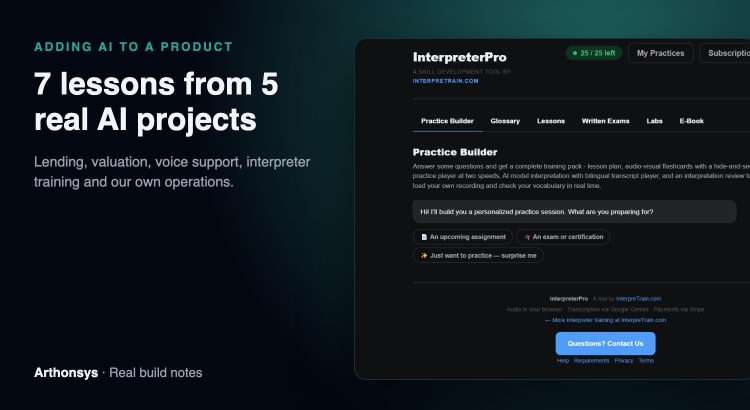
We have put AI into five very different products: a lending advisor, a business valuation platform, an internet provider’s support line, a training app for interpreters, and our own company’s daily operations. Different industries, different models, different users.
The same lessons kept coming back. Here are seven of them, each with the project where we learned it. Every product mentioned is live, so you can check the work yourself.
1. Let AI handle the words, and keep the maths in code
In Ask Ira, a lending advisor for US real-estate lender LendVent, borrowers describe their deal in plain language and get indicative pricing in real time. The AI runs the conversation, but the price comes from LendVent’s own pricing matrix. On the AI business valuation platform we built for a US advisory firm, the market-multiple and DCF valuations are calculated in code too. A model that is almost always right with numbers is still sometimes wrong, and with money that is not good enough.
2. Answer from the client’s data, not the internet
The valuation platform’s AI advisor answers from each company’s own scores, financials, documents and meeting notes, using retrieval. PigeonM’s support agent answers network questions from the customer’s own equipment lists and floor plans. Generic answers are cheap; answers grounded in the customer’s own data are why people come back.
3. Some content should stay human-vetted
InterpreterPro uses AI to write a fresh practice session for every interpreter: script, lesson plan, vocabulary and a model interpretation. But the written mock exams (135 questions each, on the real clock) are vetted content, not AI-generated. When the stakes are a certification exam, people need to trust the questions.
4. Pick the model for the job, not the brand
We rarely use one model for everything. InterpreterPro uses Anthropic Claude to write practice content, Google Cloud Text-to-Speech for narration and Google Gemini for transcription. PigeonM’s phone agent runs on the OpenAI Realtime API, with Gemini for document analysis. Each job went to the tool that did it best, and we kept the integrations swappable.
5. AI should act through tools you control
An AI that only chats is a demo. An AI that can send an OTP, create a payment link or open a CRM ticket is useful, but only if those actions run through backend functions you wrote and tested. That is how PigeonM’s agent works, and it is the line we draw on every project.
6. Keep a person on the important steps
We run our own delivery with AI agents built on Claude: daily project sync, client reports, a tracker for every date we promise a client, SEO monitoring. Every email that goes to a client is still approved by a person first. Ask Ira drafts a term sheet; the lending team reviews it. The AI saves the hours, and a person keeps the judgement. We wrote about this in our in-house AI agents case study.
7. Make it checkable
Trust grows when people can verify. PigeonM anchors network proofs on the Solana blockchain, and anyone can check one at pigeonm.com/verify. Ask Ira marks its pricing as indicative, not a commitment. Small signals like these do more for adoption than any claim about accuracy.
Where to start with your own product
Pick one outcome a customer or your team cares about, find the data the AI should answer from, list the actions it may take, and decide who approves what. Then build the smallest version that works on real examples and improve it from real usage.
See all five projects on our case studies page, or tell us about your product. The first call and the proposal are free.
Frequently asked questions
How do you add AI to an existing product?
Start with one clear outcome, connect the AI to your own data, let it act only through tested backend functions, and keep a person approving important steps. Then improve it on real usage.
Which AI model should I use?
It depends on the job. We have used Anthropic Claude for writing, OpenAI’s Realtime API for live voice, and Google Gemini for transcription and document analysis, often in the same product.
Can AI be trusted with prices and calculations?
We keep prices and valuations in tested code and use AI for the conversation around them. That way the numbers are always the same for the same input.